TARIFF GUIDE
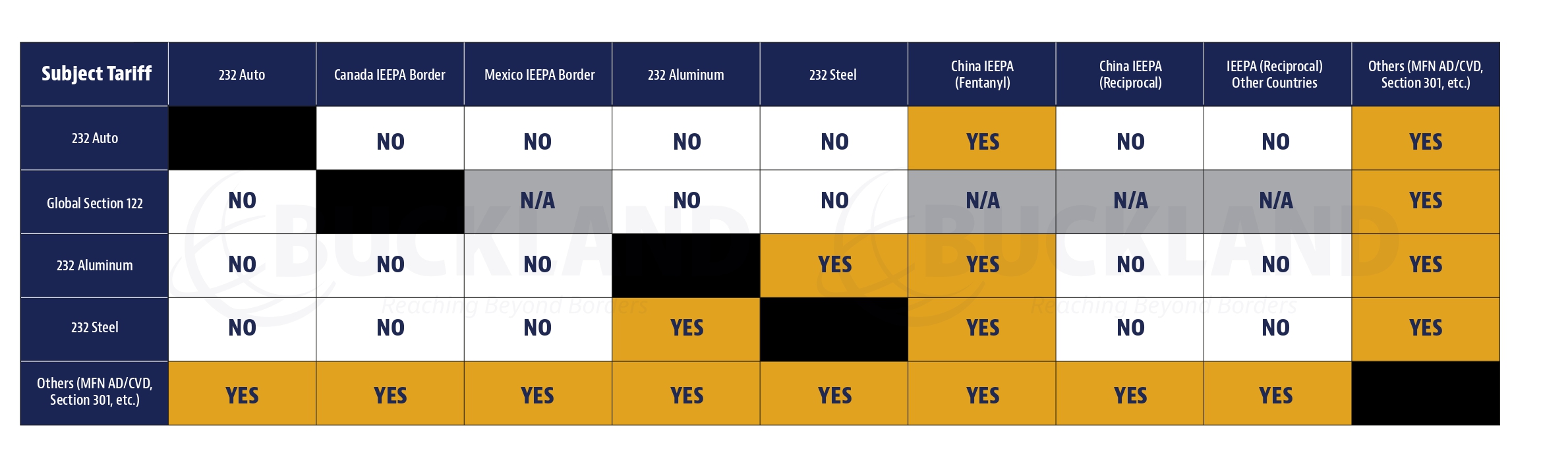
Understanding trade tariffs is crucial for effective supply chain planning. Below is a summary table of key U.S. import tariffs, including Section 232, Section 301, IEEPA, and recent executive actions.
Check the table to see which tariffs may impact your shipments.
Country | Effective Date | Duty | Details | Authority | Additive | Chapter 99 Tariff Codes | Notes | Reporting Requirements | Date Announced |
|---|---|---|---|---|---|---|---|---|---|
Mexico | 4-Mar-25 | 25% | All goods of Mexico not qualifying for USMCA | IEEPA | Superseded by automotive tariffs when the automotive tariff paid is greater than 0%, and supersedes aluminum/steel tariffs when this tariff is greater than 0%
Additive with other trade remedies or tariffs. | 9903.01.01 | Chapter 98 EXCLUDED FROM IEEPA duties | – | 1-Feb-25
|
Mexico | 4-Mar-25
| 0% | Articles the product of Mexico that are donations, by persons subject to the jurisdiction of the United States, of articles, such as food, clothing, and medicine, intended to be used to relieve human suffering | IEEPA | Superseded by automotive tariffs when the automotive tariff paid is greater than 0%.
Goods subject to this exemption are not considered “subject to” the IEEPA duty and therefore Section 232 steel/aluminum duties apply if the automotive tariff does not apply.
Additive with other trade remedies or tariffs.
| 9903.01.02 | Exempts from 25% IEEPA duty of 9901.01.01 | – | 2-Apr-25
|
Mexico | 4-Mar-25
| 0% | Articles of Mexico that are informational materials, including but not limited to, publications, films, posters, phonograph records, photographs, microfilms, microfiche, tapes, compact disks, CD ROMs, artworks, and news wire feeds. | IEEPA | Superseded by automotive tariffs when the automotive tariff paid is greater than 0%.
Goods subject to this exemption are not considered “subject to” the IEEPA duty and therefore Section 232 steel/aluminum duties apply if the automotive tariff does not apply.
Additive with other trade remedies or tariffs. | 9903.01.03 | Exempts from 25% IEEPA duty of 9901.01.01 | –
| 2-Apr-25
|
Mexico | 7-Mar-25
| 0% | All goods of Mexico origin qualifying for USMCA. | IEEPA | Superseded by automotive tariffs when the automotive tariff paid is greater than 0%.
Goods subject to this exemption are not considered “subject to” the IEEPA duty and therefore Section 232 steel/aluminum duties apply if the automotive tariff does not apply.
Additive with other trade remedies or tariffs. | 9903.01.04 | Exempts from 25% IEEPA duty of 9901.01.01 | USMCA Certificate or affavdavit | 7-Mar-25
|
Mexico | 7-Mar-25
| 10% | Potash of Mexico NOT qualifying for USMCA | IEEPA | Supersedes Section 232 steel/aluminum tariffs because not qualifying for USMCA.
Additive with other trade remedies or tariffs. | 9903.01.05 | Exempts from 25% IEEPA duty of 9901.01.01 | – | 6-Mar-25
|
Mexico | 5-Apr-25
| 0% | Exemption from reciprocal tariffs based upon Mexico origin | IEEPA | Additive with other trade remedies or tariffs. Supersedes the reciprocal tariffs. | 9903.01.27 | 9903.01.27 applied IN ADDITION TO 9903.01.01 through 9903.01.05 | –
| 2-Apr-25
|
Country | Effective Date | Duty | Details | Authority | Additive | Chapter 99 Tariff Codes | Notes | Reporting Requirements | Date Announced |
|---|---|---|---|---|---|---|---|---|---|
Canada | 4-Mar-25
| 25% | All goods of Canada not qualifying for USMCA | IEEPA | Superseded by automotive tariffs when the automotive tariff paid is greater than 0%, and supersedes aluminum/steel tariffs when this tariff is greater than 0%
Additive with other trade remedies or tariffs. | 9903.01.10 | Chapter 98 EXCLUDED FROM IEEPA duties.
See exemptions in 9903.01.11-15 | Report Chapter 99 HTS# | 1-Feb-25
|
Canada | 5-Apr-25
| 0% | Articles the product of Canada that are donations, by persons subject to the jurisdiction of the United States, of articles, such as food, clothing, and medicine, intended to be used to relieve human suffering | IEEPA | Superseded by automotive tariffs when the automotive tariff paid is greater than 0%.
Goods subject to this exemption are not considered “subject to” the IEEPA duty and therefore Section 232 steel/aluminum duties apply if the automotive tariff does not apply.
Additive with other trade remedies or tariffs. | 9903.01.11 | Exempts from 25% IEEPA duty of 9901.01.10 | Report Chapter 99 HTS# | 2-Apr-25
|
Canada | 5-Apr-25
| 0% | Articles of Canada that are informational materials, including but not limited to, publications, films, posters, phonograph records, photographs, microfilms, microfiche, tapes, compact disks, CD ROMs, artworks, and news wire feeds. | IEEPA | Superseded by automotive tariffs when the automotive tariff paid is greater than 0%.
Goods subject to this exemption are not considered “subject to” the IEEPA duty and therefore Section 232 steel/aluminum duties apply if the automotive tariff does not apply.
Additive with other trade remedies or tariffs. | 9903.01.12 | Exempts from 25% IEEPA duty of 9901.01.10 | Report Chapter 99 HTS# | 2-Apr-25
|
Canada | 7-Mar-25
| 10% | Crude oil, natural gas, lease condensates, natural gas liquids, refined petroleum products, uranium, coal, biofuels, geothermal heat, the kinetic movement of flowing water, and critical minerals, as defined by 30 U.S.C. 1606(a)(3 | IEEPA | Supersedes Section 232 steel/aluminum tariffs because not qualifying for USMCA.
Additive with other trade remedies or tariffs. | 9903.01.13 | Exempts from 25% IEEPA duty of 9901.01.10 | Report Chapter 99 HTS# | 1-Feb-25
|
Canada | 7-Mar-25
| 0% | All goods of Canada origin qualifying for USMCA. | IEEPA | Superseded by automotive tariffs when the automotive tariff paid is greater than 0%.
Goods subject to this exemption are not considered “subject to” the IEEPA duty and therefore Section 232 steel/aluminum duties apply if the automotive tariff does not apply.
Additive with other trade remedies or tariffs. | 9903.01.14 | Exempts from 25% IEEPA duty of 9901.01.10 | USMCA Certificate or affavdavit | 6-Mar-25
|
Canada | 7-Mar-25
| 10% | Potash of Canada NOT qualifying for USMCA | IEEPA | Supersedes Section 232 steel/aluminum tariffs because not qualifying for USMCA.
Additive with other trade remedies or tariffs. | 9903.01.15 | Exempts from 25% IEEPA duty of 9901.01.10 | Report Chapter 99 HTS# | 6-Mar-25
|
Canada | 5-Apr-25
| 0% | Exemption from reciprocal tariffs based upon Canadian origin | IEEPA | Additive with other trade remedies or tariffs. Supersedes the reciprocal tariffs. | 9903.01.26 | 9903.01.26 applied IN ADDITION TO 9903.01.10 through 9903.01.15 | Report Chapter 99 HTS# | 2-Apr-25
|
Country | Effective Date | Duty | Details | Authority | Additive | Chapter 99 Tariff Codes | Notes | Reporting Requirements | Date Announced |
|---|---|---|---|---|---|---|---|---|---|
China
| 6-Jul-18
| 25%
| Section 301, based on Tranche (List 1-3)
| Section 301
| Additive with all applicable trade remedies
| 9903.88.01
| Three Lists of HTS#s. Remaining Exclusion will expire 5/31/25
| Chapter 99 HTS# based on original HTS#
| 2018 |
China | 23-Aug-18
| 25%
| Section 301, based on Tranche (List 1-3)
| Section 301
| Additive with all applicable trade remedies
| 9903.88.02
| Three Lists of HTS#s. Remaining Exclusion will expire 5/31/25
| Chapter 99 HTS# based on original HTS#
| 2018
|
China | 24-Sep-18
| 25%
| Section 301, based on Tranche (List 1-3)
| Section 301
| Additive with all applicable trade remedies
| 9903.88.03
| Three Lists of HTS#s. Remaining Exclusion will expire 5/31/25
| Chapter 99 HTS# based on original HTS#
| 2018
|
China
| 1-Sep-19
| 7.50%
| Section 301, based on Tranche (List 4A)
| Section 301
| Additive with all applicable trade remedies
| 9903.88.15
| Started at 15%, reduced to 7.5% Feb. 14, 2020
| Chapter 99 HTS# based on original HTS#
| 2019
|
China | 1-Sep-23
| 50-100%
| 4 Year Review List
| Section 301
| Additive with all applicable trade remedies
| Multi – See FR Notice
| Some tariffs increased under Biden Admin.
See FR Notice Sept. 18, 2023
| Chapter 99 HTS# based on original HTS#
| 2024
|
China, HK | 4-Feb-25
| 10% | Articles of China and Hong Kong imported prior to March 4, 2025 | IEEPA | Additive with all applicable trade remedies | 9903.01.20 | Exempts from 20% IEEPA duty of 9901.01.24 | Report Chapter 99 HTS# | 1-Feb-25
|
China, HK | 4-Mar-25
| 0% | Articles the product of China and Hong Kong that are donations, by persons subject to the jurisdiction of the United States, of articles, such as food, clothing, and medicine, intended to be used to relieve human suffering | IEEPA | Additive with all applicable trade remedies | 9903.01.21 | Exempts from 20% IEEPA duty of 9901.01.24
| Report Chapter 99 HTS#
| 4-Mar-25
|
China, HK | 4-Mar-25
| 0%
| Articles of China that are informational materials, including but not limited to, publications, films, posters, phonograph records, photographs, microfilms, microfiche, tapes, compact disks, CD ROMs, artworks, and news wire feeds. | IEEPA | Additive with all applicable trade remedies | 9903.01.22 | Exempts from 20% IEEPA duty of 9901.01.24
| Report Chapter 99 HTS#
| 4-Mar-25
|
China, HK | 4-Mar-25
| 0%
| Articles the product of China and Hong Kong that: (1) were loaded onto a vessel at the port of loading, or in transit on the final mode of transport prior to entry into the United States, before 12:01 a.m. eastern standard time on February 1, 2025; and (2) are entered for consumption, or withdrawn from warehouse for consumption, on or after 12:01 a.m. eastern standard time on February 4, 2025, and before 12:01 a.m. eastern standard time on March 7, 2025
| IEEPA
| Additive with all applicable trade remedies
| 9903.01.23
| Exempts from 20% IEEPA duty of 9901.01.24
| Report Chapter 99 HTS#
| 4-Mar-25
|
China, HK
| 4-Mar-25
| 10%
| Articles of China and Hong Kong imported on or after March 4, 2025. Reduced to 10% as of November 10, 2025
| IEEPA
| Additive with all applicable trade remedies
| 9903.01.24
| Chapter 98 EXCLUDED FROM IEEPA duties
| Report Chapter 99 HTS#
| 4-Mar-25
|
China, HK, Macau | 4-Apr-25 | 10% | TEMPORARILY REPLACED BY 9903.01.25. Annex I original tariff was 34% – increased to 84% effective April 9, 2025, and then increased to 125% effective April 10, 2025. Rate was temporarily lowered, effective May 14, 2025, to 10%, expiring November 10, 2025 | IEEPA
| Does NOT stack with products on a Section 232 list or listed in Annex II
| 9903.01.63 | Reciprocal tariff does NOT apply if the HTS of the product imported falls on the Section 232 lists for aluminum/steel, the Section 232 list for automotive tariffs or if the HTS listed on Annex II list. | Report Chapter 99 HTS#
| 2-Apr-25. (Updated 11-Aug-25)
|
China, HK, Macau | 14-May-25
| 10%
| TEMPORARILY REPLACES 9903.01.63. Annex I original tariff was 34% – increased to 84% effective April 9, 2025, and then increased to 125% effective April 10, 2025. Rate was temporarily lowered, effective May 14, 2025, to 10%, expiring November 10, 2025 | IEEPA
| Does NOT stack with products on a Section 232 list or listed in Annex II
| 9903.01.25 | Reciprocal tariff does NOT apply if the HTS of the product imported falls on the Section 232 lists for aluminum/steel, the Section 232 list for automotive tariffs or if the HTS listed on Annex II list. | Report Chapter 99 HTS#
| 12-May-25 (Updated 11-Aug-25)
|
China, HK
| 14-May-25
| 54%
| Articles of China and Hong Kong, valued at or under 800 US dollars, that would otherwise qualify for the de minimis exemption, that are not sent through the international postal network. Reduced temporarily, effective May 14, 2025.
| IEEPA
| Includes 20% IEEPA on China. Additive with all other applicable trade remedies. | To be announced
| This tariff only applies to shipments valued at or below $800, which would otherwise qualify for the de minimis exemption.
| Report Chapter 99 HTS#
| 12-May-25
|
Country | Effective Date | Duty | Details | Authority | Additive | Chapter 99 Tariff Codes | Notes | Reporting Requirements | Date Announced |
|---|---|---|---|---|---|---|---|---|---|
United Kingdom | 4-Jun-25
| 25% | Steel articles Chapter 72 & 7301-7306 | Section 232 | “Supersedes the China and global reciprocal tariffs and IEEPA tariffs for Canada/Mexico.
Superseded by Section 232 for automobile tariffs when the product is subject to said tariffs. CBP has clarified that “”subject to”” means that duty of more than 0% is owed under the tariff action.
This tariff will apply if the subject good is an automotive part but qualified for USMCA.”
| 9903.81.87
| “Duty on Full value of goods
Company Exclusions valid until expiration date (2025)
GAEs revoked
FTAs do NOT exclude 232 duties
Chapter 98 does NOT exclude 232 duties.”
| “Steel License
Mill Certificate
Country of Melt & Pour must be United Kingdom | 3-Jun-25
|
United Kingdom | 4-Jun-25
| 25%
| Steel Derivatives in Chapter 73
| Section 232
| “Supersedes the China and global reciprocal tariffs and IEEPA tariffs for Canada/Mexico.
Superseded by Section 232 for automobile tariffs when the product is subject to said tariffs. CBP has clarified that “”subject to”” means that duty of more than 0% is owed under the tariff action.
This tariff will apply if the subject good is an automotive part but qualified for USMCA.”
| 9903.81.90
| “Duties on Full value of goods
HTS#s provided in 3/5/25 FR Notice, Note (m)
Chapter 98 does NOT exclude 232 duties.”
| “Mill Certificate NOT required – Except for 7307
Country of Melt & Pour must be United Kingdom
”
| 3-Jun-25
|
United Kingdom | 4-Jun-25
| 25%
| Derivatives outside Chap 73 – Chapter 84, 85, 87, 94
| Section 232
| “Supersedes the China and global reciprocal tariffs and IEEPA tariffs for Canada/Mexico.
Superseded by Section 232 for automobile tariffs when the product is subject to said tariffs. CBP has clarified that “”subject to”” means that duty of more than 0% is owed under the tariff action.
This tariff will apply if the subject good is an automotive part but qualified for USMCA.”
| 9903.81.91
| “Duties only on value of Steel content if able to provide
HTS#s provided in 3/5/25 FR Notice, Note (n) (see link)
Chapter 98 does NOT exclude 232 duties”
| “Country of Melt & Pour must be United Kingdom
Steel Content Value if known
Steel Content Weight (KG) REQUIRED”
| 3-Jun-25
|
United Kingdom | 4-Jun-25
| 25%
| Aluminum articles Chapter 76
| Section 232
| “Supersedes the China and global reciprocal tariffs and IEEPA tariffs for Canada/Mexico.
Superseded by Section 232 for automobile tariffs when the product is subject to said tariffs. CBP has clarified that “”subject to”” means that duty of more than 0% is owed under the tariff action.
This tariff will apply if the subject good is an automotive part but qualified for USMCA.”
| 9903.85.12
| Exempts from 25% IEEPA duty of 9901.01.10 | “Aluminum License
Mill Certificate
Primary & Secondary Country of Smelt must be United Kingdom
Primary Country of Cast must be United Kingdom
”
| 3-Jun-25
|
United Kingdom | 4-Jun-25
| 25%
| Aluminum Derivatives in Chapter 76
| Section 232
| “Supersedes the China and global reciprocal tariffs and IEEPA tariffs for Canada/Mexico.
Superseded by Section 232 for automobile tariffs when the product is subject to said tariffs. CBP has clarified that “”subject to”” means that duty of more than 0% is owed under the tariff action.
This tariff will apply if the subject good is an automotive part but qualified for USMCA.”
| 9903.85.13
| “Duties on Full value of goods
HTS#s provided in 3/5/25 FR Notice, Note (i) & (j)”
| “Primary & Secondary Country of Smelt must be United Kingdom
Primary Country of Cast must be United Kingdom
”
| 3-Jun-25
|
United Kingdom | 4-Jun-25
| 25%
| Aluminum Derivatives in Chapter 76
| Section 232
| “Supersedes the China and global reciprocal tariffs and IEEPA tariffs for Canada/Mexico.
Superseded by Section 232 for automobile tariffs when the product is subject to said tariffs. CBP has clarified that “”subject to”” means that duty of more than 0% is owed under the tariff action.
This tariff will apply if the subject good is an automotive part but qualified for USMCA.”
| 9903.85.14
| “Duties on Full value of goods
HTS#s provided in 3/5/25 FR Notice, Note (i) & (j)”
| “Primary & Secondary Country of Smelt must be United Kingdom
Primary Country of Cast must be United Kingdom
”
| 3-Jun-25
|
United Kingdom | 4-Jun-25
| 25%
| Derivatives outside Chap 76 – Chapter 22, 66, 83, 84, 85, 87, 88, 90, 94, 95, 96
| Section 232
| “Supersedes the China and global reciprocal tariffs and IEEPA tariffs for Canada/Mexico.
Superseded by Section 232 for automobile tariffs when the product is subject to said tariffs. CBP has clarified that “”subject to”” means that duty of more than 0% is owed under the tariff action.
This tariff will apply if the subject good is an automotive part but qualified for USMCA.”
| 9903.85.15
| “Duties only on value of Aluminum content if able to provide
HTS#s provided in 3/5/25 FR Notice, Note (k)”
| “Primary & Secondary Country of Smelt must be United Kingdom
Primary Country of Cast must be United Kingdom
Aluminum Content Weight (KG) REQUIRED
Aluminum Content Value if available”
| 3-Jun-25
|
Country | Effective Date | Duty | Details | Authority | Additive | Chapter 99 Tariff Codes | Notes | Reporting Requirements | Date Announced |
|---|---|---|---|---|---|---|---|---|---|
Brazil | 7-Aug-25
| 40% | Articles of Brazil (except listed in Annex II), other than 9903.01.78 | IEEPA | (a) The ad valorem duty imposed in this order is in addition to any other duties, fees, taxes, exactions, and charges applicable to such imports, unless subject to existing or future actions under section 232 of the Trade Expansion Act of 1962, in which case the ad valorem duty imposed in this order shall not apply.
(b) The ad valorem duty imposed in this order shall not apply to articles that are excepted by 50 U.S.C. 1702(b) or set forth in Annex II to this order, including certain silicon metal, pig iron, civil aircraft and parts and components thereof, metallurgical grade alumina, tin ore, wood pulp, precious metals, energy and energy products, and fertilizers.
(c) The ad valorem duty imposed in Executive Order 14257 of April 2, 2025 (Regulating Imports With a Reciprocal Tariff To Rectify Trade Practices That Contribute to Large and Persistent Annual United States Goods Trade Deficits), as amended, shall apply in addition to the ad valorem duty imposed in this order, when applicable pursuant to the terms of Executive Order 14257. | 9903.01.77 | Duties are in addition to reciprocal tariffs noted in Annex III for Brazil and all other applicable tariffs except Section 232. | Report Chapter 99 # | 30-Jul-25
|
Brazil | 7-Aug-25
| 0% additional | Articles the product of Brazil that (1) were loaded onto a vessel at the port of loading and in transit on the final mode of transit prior to entry into the United States, before 12:01 a.m. eastern daylight time 7 days after the date of the executive order, excluding the day the executive order is signed; and (2) are entered for consumption, or withdrawn from warehouse for consumption before 12:01 a.m. eastern daylight time on October 5, 2025 | IEEPA | Reciprocal tariff and all other appliacable tariffs still applies. | 9903.01.78 | Duties are in addition to reciprocal tariffs noted in Annex III for Brazil and all other applicable tariffs except Section 232. | Report Chapter 99 # | 30-Jul-25
|
Brazil | 7-Aug-25
| 0% additional | Articles the product of Brazil that are donations, by persons subject to the jurisdiction of the United States, such as food, clothing, and medicine, intended to be used to relieve human suffering, as provided for in subdivision (x)(ii) of U.S. note 2 to this subchapter | IEEPA | Reciprocal tariff and all other appliacable tariffs still applies. | 9903.01.79 | Duties are in addition to reciprocal tariffs noted in Annex III for Brazil and all other applicable tariffs except Section 232. | Report Chapter 99 # | 30-Jul-25
|
Brazil | 7-Aug-25
| 0% additional | Articles the product of Brazil that are informational materials, including but not limited to, publications, films, posters, phonograph records, photographs, microfilms, microfiche, tapes, compact disks, CD ROMs, artworks, and news wire feeds | IEEPA | Reciprocal tariff and all other appliacable tariffs still applies. | 9903.01.80 | Duties are in addition to reciprocal tariffs noted in Annex III for Brazil and all other applicable tariffs except Section 232. | Report Chapter 99 # | 30-Jul-25
|
Brazil | 7-Aug-25
| 0% additional | Articles the product of Brazil, classified in the subheadings enumerated in subdivision (x)(iii) of U.S. note 2 to this subchapter | IEEPA | Reciprocal tariff and all other appliacable tariffs still applies. | 9903.01.81 | Duties are in addition to reciprocal tariffs noted in Annex III for Brazil and all other applicable tariffs except Section 232. | Report Chapter 99 # | 30-Jul-25
|
Brazil | 7-Aug-25
| 0% additional | Articles of civil aircraft (all aircraft other than military aircraft); their engines, parts, and components; their other parts, components, and subassemblies; and ground flight simulators and their parts and components of Brazil, classified in the subheadings enumerated in subdivision (x)(iv) of U.S. note 2 to this subchapter | IEEPA | Reciprocal tariff and all other appliacable tariffs still applies. | 9903.01.82 | Duties are in addition to reciprocal tariffs noted in Annex III for Brazil and all other applicable tariffs except Section 232. | Report Chapter 99 # | 30-Jul-25 |
Brazil | 7-Aug-25
| 0% additional | Articles of iron or steel, derivative articles of iron or steel, articles of aluminum, derivative articles of aluminum, passenger vehicles (sedans, sport utility vehicles, crossover utility vehicles, minivans, and cargo vans) and light trucks and parts of passenger vehicles (sedans, sport utility vehicles, crossover utility vehicles, minivans, and cargo vans) and light trucks, and semi-finished copper and intensive copper derivative products, of Brazil, as provided in subdivision (x)(v) through (x)(xi) of note 2 to this subchapter | IEEPA | All other applicable tariffs still apply, but reciprocal tariff does NOT apply. | 9903.01.83 | All other applicable tariffs still apply, but reciprocal tariff does NOT apply. | Report Chapter 99 # | 30-Jul-25 |
Country | Effective Date | Duty | Details | Authority | Additive | Chapter 99 Tariff Codes | Notes | Reporting Requirements | Date Announced |
|---|---|---|---|---|---|---|---|---|---|
India
| 27-Aug-25 | 25% | Articles of India, due to India importing Russian Federation Oil | IEEPA
| Additive with reciprocal tariffs, but exempted on articles listed in Annex II of Executive Order 14257 (reciprocal tariff EO) and Section 232 | TBD | This rate of duty shall be effective with respect to goods entered for consumption, or withdrawn from warehouse for consumption, on or after 12:01 a.m. eastern daylight time 21 days after the date of this order (August 27, 2025), except for goods that (1) were loaded onto a vessel at the port of loading and in transit on the final mode of transit prior to entry into the United States before 12:01 a.m. eastern daylight time 21 days after the date of this order; and (2) are entered for consumption, or withdrawn from warehouse for consumption, before 12:01 a.m. eastern daylight time on September 17, 2025 | Report Chapter 99 #
| 11-Aug-25
|
Russia (and unknown)
| 12-Mar-2025 (updated 06/04/2025)
| 200%
| Aluminum articles that are the product of Russia or unknown country of smelt/cast | Section 232
| Supersedes the China and global reciprocal tariffs and IEEPA tariffs for Canada/Mexico.
NOTE: CBP’s ACE system currently requires IEEPA tariffs (or the exemption code if subject to USMCA) to be assesed on the non-aluminum content of a derivative.
Superseded by Section 232 for automobile tariffs when the product is subject to said tariffs. CBP has clarified that “subject to” means that duty of more than 0% is owed under the tariff action.
This tariff will apply if the subject good is an automotive part but qualified for USMCA. | 9903.85.67 | Primary & Secondary Country of Smelt
Primary Country of Cast
If unknown may report UN
| 10-Feb-25
| |
Russia (and unknown)
| 12-Mar-2025 (updated 06/04/2025)
| 200%
| Derivative aluminum articles that are Russia or unknown country of smelt/cast | Section 232
| Supersedes the China and global reciprocal tariffs and IEEPA tariffs for Canada/Mexico.
NOTE: CBP’s ACE system currently requires IEEPA tariffs (or the exemption code if subject to USMCA) to be assesed on the non-aluminum content of a derivative.
Superseded by Section 232 for automobile tariffs when the product is subject to said tariffs. CBP has clarified that “subject to” means that duty of more than 0% is owed under the tariff action.
This tariff will apply if the subject good is an automotive part but qualified for USMCA. | 9903.85.68
| Primary & Secondary Country of Smelt
Primary Country of Cast
If unknown may report UN
| 10-Feb-25
| |
All Countries
| 12-Mar-2025 (updated 06/04/2025)
| 50% if non-UK
| Steel articles Chapter 72 & 7301-7306
| Section 232
| Supersedes the China and global reciprocal tariffs and IEEPA tariffs for Canada/Mexico.
NOTE: CBP’s ACE system currently requires IEEPA tariffs (or the IEEPA exemption if USMCA applies) to be assesed on the non-steel content of a steel article in 7301-7306.
Superseded by Section 232 for automobile tariffs when the product is subject to said tariffs. CBP has clarified that “”subject to”” means that duty of more than 0% is owed under the tariff action.
This tariff will apply if the subject good is an automotive part but qualified for USMCA. | 9903.81.87
| Duty on Full value of goods for articles in chapter 72. Articles in 7301-7306 have duty assessed on the value of the steel content as of June 4th.
Company Exclusions valid until expiration date (2025)
EU Steel Extended Exclusions (STX) revoked
GAEs revoked
FTAs do NOT exclude 232 duties
Chapter 98 does NOT exclude 232 duties. | Steel License
Mill Certificate
Country of Melt & Pour
If unknown, report “”zz”” for OTHER
| 10-Feb-25
|
All Countries
| 12-Mar-2025 (updated 06/04/2025)
| 50% if non-UK
| Steel Derivatives in Chapter 73
| Section 232
| Supersedes the China and global reciprocal tariffs and IEEPA tariffs for Canada/Mexico.
NOTE: CBP’s ACE system currently requires IEEPA tariffs (or the exemption code if subject to USMCA) to be assesed on the non-steel content of a derivative.
Superseded by Section 232 for automobile tariffs when the product is subject to said tariffs. CBP has clarified that “subject to” means that duty of more than 0% is owed under the tariff action.
This tariff will apply if the subject good is an automotive part but qualified for USMCA. | 9903.81.90
| Duties on steel content as of June 4th.
HTS#s provided in 3/5/25 FR Notice, Note (m)
Chapter 98 does NOT exclude 232 duties. | Mill Certificate NOT required – Except for 7307
Country of Melt & Pour
If unknown, report “”zz”” for OTHER.
| 10-Feb-25
|
All Countries
| 12-Mar-2025 (updated 06/04/2025)
| 50% if non-UK
| Derivatives outside Chap 73 – Chapter 84, 85, 87, 94
| Section 232
| Supersedes the China and global reciprocal tariffs and IEEPA tariffs for Canada/Mexico.
NOTE: CBP’s ACE system currently requires IEEPA tariffs (or the exemption code if subject to USMCA) to be assesed on the non-steel content of a derivative.
Superseded by Section 232 for automobile tariffs when the product is subject to said tariffs. CBP has clarified that “subject to” means that duty of more than 0% is owed under the tariff action.
This tariff will apply if the subject good is an automotive part but qualified for USMCA. | 9903.81.91
| Duties only on value of Steel content if able to provide HTS#s provided in 3/5/25 FR Notice, Note (n) (see link)
Chapter 98 does NOT exclude 232 duties.
| Country of Melt & Pour
If unknow, report “”zz”” for OTHER
Steel Content Value if known
Steel Content Weight (KG) REQUIRED
| 10-Feb-25
|
All Countries
| 4-Jun-25
| 0% | Derivatives outside Chap 73 – Chapter 84, 85, 87, 94 | Section 232
| Supersedes the China and global reciprocal tariffs and IEEPA tariffs for Canada/Mexico.
This exemption will apply if processed in another country from aluminum articles that were smelted and cast in the United States | 9903.81.92 | 9903.81.92: Certain derivative steel or iron products (new derivative steel articles on or after March 12, 2025) where the derivative iron or steel product was processed in another country from steel articles that were melted and poured in the United States.
| Must be able to indicate the country of smelt is United States. | |
All Countries
| 12-Mar-2025 (updated 06/04/2025)
| 50% if non-UK, 200% Russia or Unknown
| Aluminum articles Chapter 76 (7601, 7604, 7605, 7606, 7607, 7608, 7609, 7616.99.51) | Section 232
| Supersedes the China and global reciprocal tariffs and IEEPA tariffs for Canada/Mexico.
NOTE: CBP’s ACE system currently requires IEEPA tariffs (or the exemption code if subject to USMCA) to be assesed on the non-aluminum content of a derivative.
Superseded by Section 232 for automobile tariffs when the product is subject to said tariffs. CBP has clarified that “subject to” means that duty of more than 0% is owed under the tariff action.
This tariff will apply if the subject good is an automotive part but qualified for USMCA. | 9903.85.02
| Duties on value of aluminum article.
Duty increased from 10% to 25%
GAEs expired
Chapter 98 does NOT exclude 232 duties | Aluminum License
Mill Certificate
Primary & Secondary Country of Smelt
Primary Country of Cast
If unknown may report country of origin of UN and pay 200%
| 10-Feb-25
|
All Countries | 12-Mar-2025 (updated 06/04/2025) | 50% if non-UK and non-Russia
200% Russia or Unknown
| Aluminum Derivatives in Chapter 76
| Section 232
| Supersedes the China and global reciprocal tariffs and IEEPA tariffs for Canada/Mexico.
NOTE: CBP’s ACE system currently requires IEEPA tariffs (or the exemption code if subject to USMCA) to be assesed on the non-aluminum content of a derivative.
Superseded by Section 232 for automobile tariffs when the product is subject to said tariffs. CBP has clarified that “subject to” means that duty of more than 0% is owed under the tariff action.
This tariff will apply if the subject good is an automotive part but qualified for USMCA. | 9903.85.04
| Duties on value of aluminum content, updated as of June 4th, 2025
HTS#s provided in 3/5/25 FR Notice, Note (i) & (j) | Primary & Secondary Country of Smelt
Primary Country of Cast
If unknown may report country of origin of UN and pay 200%
| 10-Feb-25
|
All Countries
| 12-Mar-2025 (updated 06/04/2025) | 50% if non-UK and non-Russia
200% Russia or Unknown | Aluminum Derivatives in Chapter 76
| Section 232
| Supersedes the China and global reciprocal tariffs and IEEPA tariffs for Canada/Mexico.
NOTE: CBP’s ACE system currently requires IEEPA tariffs (or the exemption code if subject to USMCA) to be assesed on the non-aluminum content of a derivative.
Superseded by Section 232 for automobile tariffs when the product is subject to said tariffs. CBP has clarified that “subject to” means that duty of more than 0% is owed under the tariff action.
This tariff will apply if the subject good is an automotive part but qualified for USMCA. | 9903.85.07
| Duties on value of aluminum content, updated as of June 4th, 2025
HTS#s provided in 3/5/25 FR Notice, Note (i) & (j) | Primary & Secondary Country of Smelt
Primary Country of Cast
If unknown may report country of origin of UN and pay 200% | 10-Feb-25
|
All Countries
| 12-Mar-2025 (updated 06/04/2025)
| 50% if non-UK and non-Russia
200% Russia or Unknown | Derivatives outside Chap 76 – Chapter 22, 66, 83, 84, 85, 87, 88, 90, 94, 95, 96
| Section 232
| Supersedes the China and global reciprocal tariffs and IEEPA tariffs for Canada/Mexico.
NOTE: CBP’s ACE system currently requires IEEPA tariffs (or the exemption code if subject to USMCA) to be assesed on the non-aluminum content of a derivative.
Superseded by Section 232 for automobile tariffs when the product is subject to said tariffs. CBP has clarified that “subject to” means that duty of more than 0% is owed under the tariff action.
This tariff will apply if the subject good is an automotive part but qualified for USMCA. | 9903.85.08
| Duties only on value of Aluminum content if able to provide
HTS#s provided in 3/5/25 FR Notice, Note (k) | Primary & Secondary Country of Smelt
Primary Country of Cast
If unknown may report country of origin
Aluminum Content Weight (KG) REQUIRED
Aluminum Content Value if available
| 10-Feb-25
|
All Countries
| 4-Jun-25
| 0% | Derivatives outside Chap 76 – Chapter 22, 66, 83, 84, 85, 87, 88, 90, 94, 95, 96 processed in another country from aluminum articles that were smelted and cast in the United States | Section 232
| Supersedes the China and global reciprocal tariffs and IEEPA tariffs for Canada/Mexico.
This exemption will apply if processed in another country from aluminum articles that were smelted and cast in the United States | 9903.85.09
| 9903.85.09: Derivative aluminum articles listed in subdivision (j) or (k) (new derivative aluminum articles), where the derivative aluminum products were processed in another country from aluminum articles that were smelted and cast in the United States.
Chapter 98 does NOT exclude 232 duties
Additive with IEEPA on Mexico and Canada
| Must be able to indicate the country of smelt is United States.
| |
All Countries
| 3-Apr-25
| 25%
| Automobiles – Headings 8703 and 8704 where 9903.94.02 does not apply. Exclusive with reciprocal tariffs on China and 10% on global countries (excluding Canada and Mexico). | Section 232
| Supersedes the China and global reciprocal tariffs.
Supersedes IEEPA Canada and IEEPA Mexico, as well as Section 232 for steel/aluminum only if the article is “subject to” this tariff, meaning this tariff was paid (greater than 0% rate).
If this tariff is eliminated by USMCA eligibility or because it is not part of a passenger vehicle, the Section 232 for steel/aluminum will apply (if the product is on the Section 232 lists for steel/aluminum). | 9903.94.01
| Passenger vehicles and light trucks listed in select headings of 8703 and 8704 where headings 9903.94.02, 9903.94.03 and 9903.94.04 do not apply.
Chapter 98 does NOT exclude 232 duties
Additive with IEEPA on Mexico and Canada
| Report Chapter 99 HTS#
| 26-Mar-25
|
All Countries
| 3-Apr-25
| 25% on non-US Content
| Automobiles – Headings 8703, 8704 – qualified for USMCA
| Section 232
| Supersedes the China and global reciprocal tariffs.
Supersedes IEEPA Canada and IEEPA Mexico, as well as Section 232 for steel/aluminum only if the article is “subject to” this tariff, meaning this tariff was paid (greater than 0% rate). | 9903.94.03
| Applies to the non-U.S. content of passenger vehicles and light trucks eligible for special tariff treatment under the United States-Mexico-Canada Agreement (USMCA), upon approval from the Secretary of Commerce to apply the 25% ad valorem rates of duty exclusively to the value of the non-U.S. content of the automobile. | Report Chapter 99 HTS#; Report content of non-US origin content.
| 26-Mar-25
|
All Countries
| 3-Apr-25
| 0%
| Headings 8703, 8704 – NOT passenger vehicles or light trucks
| Section 232
| Supersedes the China and global reciprocal tariffs.
If this exemption applies, Section 232 for steel/aluminum will apply (if the product is on the Section 232 lists for steel/aluminum). If Section 232 does not apply, the IEEPA tariffs for Canada/Mexico will apply (if not qualified for USMCA). | 9903.94.02
| Applies to imports classifiable under the Chapter 87 HTSUS classifications listed above,
1) that are not passenger vehicles and light trucks; or
2) the U.S. content of passenger vehicles and light trucks that have received approval from the Secretary of Commerce as noted under HTSUS 9903.94.03.
| Report Chapter 99 HTS#
| 26-Mar-25
|
All Countries
| 3-Apr-25
| 0%
| Automobiles – Headings 8703, 8704 – Antiques
| Section 232
| Supersedes the China and global reciprocal tariffs.
If this exemption applies, Section 232 for steel/aluminum will apply (if the product is on the Section 232 lists for steel/aluminum). If Section 232 does not apply, the IEEPA tariffs for Canada/Mexico will apply (if not qualified for USMCA). | 9903.94.04
| Applies to all entries of passenger vehicles and light trucks from all countries classifiable in the headings or subheadings listed above that were manufactured in a year at least 25 years prior to the year of the date of entry.
| Report Chapter 99 HTS#
| 26-Mar-25
|
All Countries
| 3-May-25
| 25%
| A 25% tariff will be imposed on auto parts
| Section 232
| Supersedes the China and global reciprocal tariffs.
Supersedes IEEPA Canada and IEEPA Mexico, as well as Section 232 for steel/aluminum only if the article is “subject to” this tariff, meaning this tariff was paid (greater than 0% rate).
If this tariff is eliminated by USMCA eligibility or because it is not part of a passenger vehicle, the Section 232 for steel/aluminum will apply (if the product is on the Section 232 lists for steel/aluminum). | 9903.94.05
| Except for 9903.94.06, effective with respect to entries on or after May 3, 2025, automobile parts, as provided for in subdivision (g) of U.S. note 33 of subchapter III of Chapter 99
| Report Chapter 99 HTS#
| 26-Mar-25
|
All Countries
| 3-May-25
| 0%
| Automobile Parts – Qualifying for USMCA or not part of passenger vehicles and light trucks | Section 232
| Supersedes the China and global reciprocal tariffs.
If this exemption applies, Section 232 for steel/aluminum will apply (if the product is on the Section 232 lists for steel/aluminum). | 9903.94.06
| Heading 9903.94.06 applies to all entries of articles classifiable under provisions of the HTSUS enumeraged subdivision (g) of this note
(i) that are eligible for special tariff treatment under the United States-Mexico-Canada Agreement (USMCA), other than automobile knock-down kits or parts compilations; or
(ii) that are not parts of passenger vehicles (sedans, sport utility vehicles, crossover utility vehicles, minivans and cargo vans) and light trucks.
The ad valorem tariff of 25 percent shall not apply “”…to automobile parts that qualify for preferential treatment under the USMCA until such time that the Secretary, in consultation with CBP, establishes a process to apply the tariff exclusively to the value of the non-U.S. content of such automobile parts and publishes notice in the Federal Register.
| Report Chapter 99 HTS#; Report content of non-US origin content.
| 26-Mar-25
|
All Countries except Canada, Mexico and China.
| 7-Aug-25
| 10%
| All goods from all countries except countries listed in Annex I and except for Canada and Mexico.
Temporarily includes China until November 2025, when it will be replaced by 9903.01.63. | IEEPA
| Does NOT apply if Section 232 automotive applies, or if the HTS is on the Annex II list. Will apply to the value of non-aluminum/steel/copper content if subject to Section 232 for aluminum/steel and/or copper | 9903.01.25 | All countries (except Annex I countries, Canada and Mexico at 10% effective August 7, 2025
*Except products in heading 9903.01.26-9903.01.33 and 9903.01.34 (see Annex III Tab)
Chapter 98 EXCLUDED FROM IEEPA duties | Report Chapter 99 HTS#
| 31-Jul-25
|
All Countries
| 5-Apr-25
| 0%
| Goods in Transit
| IEEPA
| Does NOT stack with products on a Section 232 list or listed in Annex II | 9903.01.28
| Goods loaded onto a vessel at the port of loading and in transit on the final mode of transit prior to entry into the U.S., before 12:01 ETD on April 5, 2025
Entered for consumption on or after 12:01 EDT April 5, 2025 and before 12:01 EDT May 27, 2025.
| Report Chapter 99 HTS#
| 2-Apr-25
|
All Countries
| 5-Apr-25
| 0%
| Products Excluded in Annex II
| IEEPA
| Does NOT stack with products on a Section 232 list or listed in Annex II | 9903.01.32
| Listed products are not subject to the addtional IEEPA Reciprocal tariffs
| Report Chapter 99 HTS#
| 5-Apr-25
|
All Countries
| 6-Apr-25
| 0%
| Goods Subject flagging for Section 232 Tariffs
| IEEPA
| Does NOT stack with products on a Section 232 list or listed in Annex II
| 9903.01.33
| Articles of Steel and Iron and Derivatives
Articles of Aluminum and Derivatives
Passenger Vehicles and Light Trucks
Parts of Passenger Vehicles and Light Trucks | Report Chapter 99 HTS#
| 2-Apr-24
|
Countries listed in Annex I
| 7-Aug-2025
| Specific to Country
| All. Does NOT apply if Section 232 automotive applies, or if the HTS is on the Annex II list. Will apply to the value of non-aluminum/steel/copper content if subject to Section 232 for aluminum/steel and/or copper
| IEEPA
| Does NOT stack with products on a Section 232 list or listed in Annex II
| See Annex III Tab
| Country Specific Rates – Noted in Annex I and Annex III
Effective date August 7, 2025
Goods subject to Section 232 exempt from Reciprocal tariffs
Chapter 98 EXCLUDED FROM IEEPA duties | Report Chapter 99 HTS#
| 4-Apr-2025 and updated 07-Jul-2025 and 31-Jul-25
|
To be announced
| 7-Aug-25
| 40%
| Articles determined to have been transsshipped to evade reciprocal duties | IEEPA
| Stacks with all other applicable duties
| 9903.02.01
| Articles the product of any country determined by U.S. Customs and Border Protection to have been transsshipped to evade applicabe duties under section 2 of Executive Order 14326, 90 Fed. Reg. 37963
| Report Chapter 99 HTS# | 31-Jul-25
|
To be announced
| 2-Apr-25
| 25%
| 25% tariff on all goods imported from countries that import Venezuelan oil.
| IEEPA
| To be announced
| To be announced
| Announced but not yet implemented. No effective date or list of countries affected published yet.
| To be announced
| 24-Mar-25
|
All Countries | 14-oct-25 | 10% | Softwood timber and lumber | Section 232 | Supersedes the China and global reciprocal tariffs and IEEPA tariffs for Canada/Mexico, as well as reciprocal tariffs against Brazil.
Superseded by Section 232 for automobile tariffs when the product is subject to said tariffs. CBP has clarified that “”subject to”” means that duty of more than 0% is owed under the tariff action. | 9903.76.01 | 29-sept-25 | ||
All Countries | 14-oct-25 | 25% (10% for UK, 15% for Japan, 15% for EU) | Upholstered wooden furniture products | Section 232 | Supersedes the China and global reciprocal tariffs and IEEPA tariffs for Canada/Mexico, as well as reciprocal tariffs against Brazil.
Superseded by Section 232 for automobile tariffs when the product is subject to said tariffs. CBP has clarified that “”subject to”” means that duty of more than 0% is owed under the tariff action. | 9903.76.02 | Note: See 9903.76.20 for UK, 9903.76.21 for JP and 9903.76.22 for EU | 29-sept-25 | |
All Countries | 14-oct-25 | 25% | Completed kitchen cabinets and vanities and parts of kitchen cabinets and vanities. | Section 232 | Supersedes the China and global reciprocal tariffs and IEEPA tariffs for Canada/Mexico, as well as reciprocal tariffs against Brazil.
Superseded by Section 232 for automobile tariffs when the product is subject to said tariffs. CBP has clarified that “”subject to”” means that duty of more than 0% is owed under the tariff action. | 9903.76.03 | Note: See 9903.76.20 for UK, 9903.76.21 for JP and 9903.76.22 for EU | 29-sept-25 | |
All Countries | 14-oct-25 | 0% | Exemption that applies to products classified under any of the listed provisions in subdivision (f) of this note that are other than completed wooden
kitchen cabinets or vanities or parts of wooden kitchen cabinets or vanities. | Section 232 | Supersedes the China and global reciprocal tariffs and IEEPA tariffs for Canada/Mexico, as well as reciprocal tariffs against Brazil.
Superseded by Section 232 for automobile tariffs when the product is subject to said tariffs. CBP has clarified that “”subject to”” means that duty of more than 0% is owed under the tariff action. | 9903.76.04 | 29-sept-25 | ||
All Countries | 1-nov-25 | 25% | Medium- and heavy-duty
vehicles as provided for in
subdivision (b) of U.S. note 38
to chapter 99 subchapter III | Section 232 | Supersedes Section 232 for steel, aluminum, copper, IEEPA from Canada and Mexico and lumber, even if USMCA applies. Does not stack with IEEPA reciprocal tariffs. | 9903.74.01 | 17-oct-25 | ||
All Countries | 1-nov-25 | 10% | Buses and other vehicles
classified in HTSUS heading
8702 as provided for in
subdivision (c) of U.S. note 38
to chapter 99 subchapter III | Section 232 | Supersedes Section 232 for steel, aluminum, copper, IEEPA from Canada and Mexico and lumber, even if USMCA applies. Does not stack with IEEPA reciprocal tariffs. | 9903.74.02 | 17-oct-25 | ||
All Countries | 1-nov-25 | 25% upon the value of non-U.S. content | Medium- and heavy-duty
vehicles, as provided for in
subdivision (d) of U.S. note 38
to chapter 99 subchapter III | Section 232 | Supersedes Section 232 for steel, aluminum, copper, IEEPA from Canada and Mexico and lumber, even if USMCA applies. Does not stack with IEEPA reciprocal tariffs. | 9903.74.03 | U.S. content provision. Per CBP: DO NOT REPORT ANY DUTIES BASED ON NON-U.S. CONTENT UNDER THIS HTSUS CLASSIFICATION UNTIL FURTHER GUIDANCE IS PROVIDED | 17-oct-25 | |
All Countries | 1-nov-25 | 0% | Heavy truck exclusion. Articles that are classifiable under the provisions of MHDV tariffs but are not medium- and heavy-duty vehicles. | Section 232 | Supersedes Section 232 for steel, aluminum, copper, IEEPA from Canada and Mexico and lumber, even if USMCA applies. Does not stack with IEEPA reciprocal tariffs. | 9903.74.05 | 17-oct-25 | ||
All Countries | 1-nov-25 | 0% | U.S. content of medium- and heavy-duty vehicles described in subdivision (d) of chapter 99 subchapter III | Section 232 | Supersedes Section 232 for steel, aluminum, copper, IEEPA from Canada and Mexico and lumber, even if USMCA applies. Does not stack with IEEPA reciprocal tariffs. | 9903.74.06 | Per CBP: DO NOT REPORT ANY DUTIES BASED ON U.S. CONTENT UNDER THIS HTSUS CLASSIFICATION UNTIL FURTHER GUIDANCE IS PROVIDED | 17-oct-25 | |
All Countries | 1-nov-25 | 0% | Medium- and heavy-duty vehicles from all countries
classifiable in the provisions enumerated in subdivisions (b) or (c) of this note that were manufactured in
a year at least 25 years prior to the year of the date of entry | Section 232 | Supersedes Section 232 for steel, aluminum, copper, IEEPA from Canada and Mexico and lumber, even if USMCA applies. Does not stack with IEEPA reciprocal tariffs. | 9903.74.07 | 17-oct-25 | ||
All Countries | 1-nov-25 | 25% | Medium- and heavy-duty
vehicle parts, as provided for in
subdivision (i) of U.S. note 38
to subchapter III of chapter 99 | Section 232 | Supersedes Section 232 for steel, aluminum, copper, IEEPA from Canada and Mexico and lumber, even if USMCA applies. Does not stack with IEEPA reciprocal tariffs. | 9903.74.08 | 17-oct-25 | ||
All Countries | 1-nov-25 | 25% | Medium- and heavy-duty
vehicle parts, as provided for in
subdivision (j) of U.S. note 38
to subchapter III of chapter 99 | Section 232 | Supersedes Section 232 for steel, aluminum, copper, IEEPA from Canada and Mexico and lumber, even if USMCA applies. Does not stack with IEEPA reciprocal tariffs. | 9903.74.09 | 17-oct-25 | ||
All countries | 1-nov-25 | 0% | Articles meeting the requirements of USMCA, other than medium- and heavy-duty vehicle knock-down kits or parts compilations | Section 232 | Supersedes Section 232 for steel, aluminum, copper, IEEPA from Canada and Mexico and lumber, even if USMCA applies. Does not stack with IEEPA reciprocal tariffs. | 9903.74.10 | 17-oct-25 | ||
All Countries | 1-nov-25 | 0% | Articles that are determined to be not parts of medium- and heavy-duty vehicles | Section 232 | Supersedes Section 232 for steel, aluminum, copper, IEEPA from Canada and Mexico and lumber, even if USMCA applies. Does not stack with IEEPA reciprocal tariffs. | 9903.74.11 | 17-oct-25 | ||
All Countries | 1-nov-25 | 25% | Automobile parts when certified by
the importer of record that such parts will be used for automobile production or repair activity in the
United States | Section 232 | Supersedes Section 232 for steel, aluminum, copper, IEEPA from Canada and Mexico and lumber, even if USMCA applies. Does not stack with IEEPA reciprocal tariffs. | 9903.94.07 | Requires declaring that the part is considered an auto part. See 9903.94.33 for UK, 9903.94.44 and 9903.94.45 for EU, 9903.94.54 and 9903.94.54 for Japan.
Heading 9903.94.07 does not apply to the following:
(i) articles classifiable in HTSUS chapters 72, 73 or 76;
(ii) articles classifiable in the provisions of subdivision (g) of this note; or
(iii) articles classifiable in the provisions of subdivision (i) of U.S. note 38 to this subchapter. | 17-oct-25 | |
All Countries | 3/12/2025 (updated 06/04/2025) | 50% if non-UK | Steel Derivatives in Chapter 73 | Section 232 | Supersedes the China and global reciprocal tariffs and IEEPA tariffs for Canada/Mexico.
NOTE: CBP’s ACE system currently requires IEEPA tariffs (or the exemption code if subject to USMCA) to be assesed on the non-steel content of a derivative.
Superseded by Section 232 for automobile tariffs when the product is subject to said tariffs. CBP has clarified that “”subject to”” means that duty of more than 0% is owed under the tariff action.
This tariff will apply if the subject good is an automotive part but qualified for USMCA. | 9903.81.89 | Duties on steel content as of June 4th.
HTS#s provided in 3/5/25 FR Notice, Note (m)
Chapter 98 does NOT exclude 232 duties. | Mill Certificate NOT required – Except for 7307
Country of Melt & Pour
If unknown, report “”zz”” for OTHER | 10-feb-25 |
All Countries | 3/12/2025 (updated 06/04/2025) | 50% if non-UK | Steel Derivatives in Chapter 73 | Section 232 | Supersedes the China and global reciprocal tariffs and IEEPA tariffs for Canada/Mexico.
NOTE: CBP’s ACE system currently requires IEEPA tariffs (or the exemption code if subject to USMCA) to be assesed on the non-steel content of a derivative.
Superseded by Section 232 for automobile tariffs when the product is subject to said tariffs. CBP has clarified that “”subject to”” means that duty of more than 0% is owed under the tariff action.
This tariff will apply if the subject good is an automotive part but qualified for USMCA. | 9903.81.90 | Duties on steel content as of June 4th.
HTS#s provided in 3/5/25 FR Notice, Note (m)
Chapter 98 does NOT exclude 232 duties. | Mill Certificate NOT required – Except for 7307
Country of Melt & Pour
If unknown, report “”zz”” for OTHER | 10-feb-25 |
All Countries | 3/12/2025 (updated 06/04/2025) | 50% if non-UK | Steel derivatives outside Chap 73 – Chapter 84, 85, 87, 94 | Section 232 | Supersedes the China and global reciprocal tariffs and IEEPA tariffs for Canada/Mexico.
NOTE: CBP’s ACE system currently requires IEEPA tariffs (or the exemption code if subject to USMCA) to be assesed on the non-steel content of a derivative.
Superseded by Section 232 for automobile tariffs when the product is subject to said tariffs. CBP has clarified that “”subject to”” means that duty of more than 0% is owed under the tariff action.
This tariff will apply if the subject good is an automotive part but qualified for USMCA. | 9903.81.91 | Duties only on value of Steel content if able to provide
HTS#s provided in 3/5/25 FR Notice, Note (n) (see link)
Chapter 98 does NOT exclude 232 duties | Country of Melt & Pour
If unknow, report “”zz”” for OTHER
Steel Content Value if known
Steel Content Weight (KG) REQUIRED | 10-feb-25 |
Disclaimer: The information contained in this document reflects Buckland's current understanding of the subject matter and is provided for informational purposes only. It is the responsibility of importers to ensure compliance with all applicable laws and regulations. This document is not intended to constitute legal advice and should not be used as a substitute for professional consultation. Buckland disclaims any liability for actions taken based on the information provided herein. By downloading this document, you acknowledge that the information may be subject to change due to the evolving regulatory environment. This document is intended solely for Buckland clients and must not be distributed or shared with third parties.
Download our Tariff Guide
Fill out the form below and directly download this guide.
FAQS
Stay informed on key tariffs and trade measures affecting your imports. This FAQ document from Buckland covers Section 232, Section 301, IEEPA actions, and new reciprocal tariffs all in one place.
A trade remedy is any additional tariffs beyond the ad valorem tariff (general duty rate) the United States imposes on imports from foreign countries.
Section 301 is a tariff of 25% or 7.5% for most (but not all) goods from China.
- Section 232 on steel and aluminum is 25% on certain steel and aluminum articles, and 25% on the steel and/or aluminum content (depending upon which list they are on) for steel and aluminum derivatives outside of chapters 73 and 76.
- Section 232 was also used to implement the 25% tariff on automobiles and certain automotive parts.
These are a new tariff imposed under the authority of Section 232. You can view the Federal Register notice with the list of tariff codes here.
IEEPA is The International Emergency Economic Powers Act. It is a law that grants the President broad authority to regulate economic transactions in response to an unusual and extraordinary threat to U.S. national security, foreign policy, or economy.
- Yes. It was first used in February 2025 to impose a 10% tariff on all goods from China and Hong Kong. That 10% increased to 20% on all goods from China and Hong Kong in March 2025. In March 2025 it was used to impose a 25% (10% for select products) on all goods from Canada and Mexico. An exemption to the additional tariff was enacted on March 7th, allowing goods that qualify under USMCA to avoid the IEEPA duties on Canada and Mexico.
- IEEPA was also used to impose the reciprocal tariffs announced Wednesday April 2nd, 2025. It imposes a baseline 10% on all countries except the ~60 named by the government. Those named countries will receive tariffs of 20% or higher.
The reciprocal tariffs were imposed by the President through an executive order signed April 2nd, 2025. It is imposed using the authority of IEEPA, and it imposes a baseline 10% on all countries except the ~60 named by the government. Those named countries will receive tariffs of 11% or higher. Tariffs on named countries begin April 9th, 20205, while countries not named (not including the named countries) go into effect April 5th. See Annex I for the list of countries named with specific rates.
The reciprocal tariffs do not apply if the good falls under Section 232 for either steel & aluminum or the automotive tariffs. There are also further exemptions, such as copper, pharmaceuticals, semiconductors, lumber articles, certain critical minerals, and energy and energy products, listed under Annex II. Goods covered under future trade remedies are also excluded from the reciprocal tariffs.
The President signed an executive order which imposed a new tariff. “On or after April 2, 2025, a tariff of 25 percent may be imposed on all goods imported into the United States from any country that imports Venezuelan oil, whether directly from Venezuela or indirectly through third parties. Duties imposed by this order will be supplemental to duties on imports already imposed pursuant to IEEPA, section 232 of the Trade Expansion of 1962, section 301 of the Trade Act of 1974, or any other authority.
Buckland is watching the Federal Register daily for an additional official notice with more details about which countries are affected and when the 25% tariff will begin being collected. We do know that China is the largest importer of Venezuelan oil, so it is almost certain China will face the additional 25% tariff.
They are additive with all trade remedies except the reciprocal tariffs. If the Section 232 automotive tariffs apply, the reciprocal tariffs do not apply.
Currently, China faces many trade remedies, including Section 301 duties on most products from China, Section 232 duties on steel and aluminum, IEEPA duties on all goods from China, automotive duties on all automobiles and most automotive parts, and reciprocal tariffs.
You can go to the White House website directly where Presidential Actions are listed. You can then click the tabs at the top for Executive orders or Proclamations.
The Annex lists referenced in executive orders are included when the executive order is published in the Federal Register. You can access the Federal Register at this link.
Once a Federal Register notice is published, CBP will often issue Guidance in the form of a CSMS (Cargo Systems Messaging Service) message. They can be found at this link.
Importers are encouraged to subscribe to newsletters from trusted compliance and law firms. Buckland shares important industry updates once they are made official (such as a signed EO, or a Federal Register notice). You can sign up for Buckland’s newsletter here and see the archive of news articles Buckland has sent out here.
Email your Account Manager (AM) or National Account Manager (NAM). They can help direct you. If you do not have one, or do not know who they are, please email clientsupportus@buckland.com. They will help assist in receiving an answer to your question(s).
IEEPA authorizes the president to regulate imports as a way to “deal with any unusual and extraordinary threat, which has its source in whole or substantial part outside the United States, to the national security, foreign policy, or economy of the United States.” 50 U.S.C. §§ 1701-1702. In this instance, President Trump declared a national emergency “arising from conditions reflected in large and persistent annual U.S. goods trade deficits” that is “driven by the absence of reciprocity in our trade relationships and other harmful policies.” You can read the Order here. Some companies have argued that IEEPA gives the president power to imposed these tariffs – these challenges are pending.
The White House cited the Foreign Trade Barriers report published by the Office of the United States Trade Representative (USTR) in the Order, explaining that the report “details a great number of non-tariff barriers to U.S. exports around the world on a trading-partner by trading-partner basis.” You can access the report in the link above, which provides a country-by-country assessment of trade barriers.
As of April 5, 2025, at 12:01 a.m. EDT, a baseline 10 percent tariff applies to imported products of all countries except Canada and Mexico.
On April 9, 2025, at 12:01 a.m. EDT, the 10 percent rate increased to a new rate for certain countries. The list of rates for each specified country can be found in Annex I of the Order. These individualized Reciprocal Tariffs purported to target countries with which the U.S. has the largest trade deficits. This was a tariff rate increase, not a tariff in addition, to the baseline 10 percent imposed April 5. The increased rates ranged from 11 percent to 50 percent.
Increases Paused for Most Countries: The increased Reciprocal Tariff rates stayed in place only for one day. On April 9, the White House announced via a new executive order that, with the exception of China, these country-specific rates would be suspended, effective April 10, 2025, at 12:01 a.m. EDT. A a result, all increased Reciprocal Tariff rates (except the rate imposed on China-origin products) returned to the original 10 percent baseline Reciprocal Tariff rate. The suspension of the increased Reciprocal Tariff rates will last for 90 days. Unless otherwise modified, the increased rates will automatically apply to the countries identified in Annex I on July 9, 2025, even without a further executive order.
China Subject to Increased Rates: In the same order, the White House announced that China’s Reciprocal Tariff rate would be raised to 125 percent. However, as we discuss in detail below, the China Reciprocal Tariff rate will be reduced back to 10 percent for a period of 90 days starting at May 14, 2025, at 12:01 a.m. EDT. After 90 days, the rate will return to the original 34 percent Reciprocal Tariff rate for China.
In addition to Annex I, which identifies the countries potentially subject to higher Reciprocal Tariff rates, the April 2 order includes two other annexes: Annex II contains a list of products excepted from the Reciprocal Tariffs according to the product’s Harmonized Tariff Schedule (HTS) code and Annex III contains the new Chapter 99 HTS codes that will be used to classify these products, their corresponding duty rates, and additional tariff exceptions. Annex III also includes language that was inserted into the HTS Notes as additional guidance on how to interpret and apply the Reciprocal Tariffs.
Tariff exposure is based on the product’s country of origin, not the country of export. Therefore, if a product’s country of origin is China and it is exported from Mexico, the product will still be subject to the 10 percent Reciprocal Tariff on China, even though Mexico is currently excepted from the Reciprocal Tariffs.
The Reciprocal Tariffs will not apply to goods loaded onto a vessel at the port of loading and in transit on the final mode of transit before 12:01 a.m. EDT on the effective date and entered for consumption or withdrawn from the warehouse for consumption after 12:01 a.m. EDT on the effective date and before 12:01 a.m. EDT on May 27, 2025.
Neither the administration nor CBP has signaled whether a similar “in transit” exception will be available to importers when the country-specific Reciprocal Tariffs resume on July 9, 2025. It is similarly unclear whether an “in transit” exception will be available if and when the 34 percent China-origin Reciprocal Tariff resumes.
If at least 20 percent of the value of the imported good is U.S.-originating, meaning the components are produced entirely in or substantially transformed in the U.S., then the Reciprocal Tariffs apply only to the value of the non-U.S.-origin content of the product.
Yes. Some products will not be subject to the Reciprocal Tariffs. Excepted articles include:
- Articles subject to 50 USC § 1702(b) (i.e., personal communications, donations, personal luggage)
- Steel/aluminum articles and automobiles/auto parts already subject to Section 232 tariffs
- Certain articles of copper and lumber, pharmaceuticals, and semiconductors listed in Annex II
- All articles that may become subject to future Section 232 tariffs
- Articles subject to Column 2 rates of duty from countries with which the U.S. does not have normal trade relations (Belarus, Cuba, North Korea, and Russia)
- Bullion
- Energy and other certain minerals that are not available in the U.S.
- Other articles delineated in Annex II of the Order
On April 11, 2025, Trump issued a memorandum clarifying which semiconductor products were excluded from Reciprocal Tariffs. The memorandum explains that smartphones, automatic data processing machines, magnetic or optical readers, flat panel modules, electronic integrated circuits, and certain semiconductor devices and parts are included within the meaning of the semiconductors exemption and therefore exempted from Reciprocal Tariffs. The clarification extends back to April 5, 2025, allowing importers to retroactively claim this exemption if the semiconductors definition now applies to a product already imported.
On May 8, 2025, the U.S. and U.K. reached a trade deal reducing tariff rates for certain U.K.-origin products, but leaving the 10 percent Reciprocal Tariff in effect. It is possible more country-specific trade deals will emerge that could exempt certain nations or industries from Reciprocal Tariffs.
In response to a retaliatory tariff levied by China on U.S. goods, Trump signed a second executive order on April 8 that amends the Reciprocal Tariff on China, increasing the tariff rate from 34 percent to 84 percent. As mentioned above, this rate then was increased to 125 percent on April 9, via the third executive order. Effective 12:01 a.m. EDT on April 10, 2025, products of China are subject to a Reciprocal Tariff of 84 percent in addition to all other applicable tariffs.
On May 12, 2025, the U.S. and China released a joint statement indicating that each country would reduce its tariffs on the other while negotiations continue. According to the White House’s executive order implementing the agreement, the U.S. will reduce the Reciprocal Tariff rate on China-origin goods to 10 percent for 90 days, beginning May 14 at 12:01 a.m. EDT. This action lowers the China Reciprocal Tariff rate to the same rate that is currently imposed on most nations. After this 90-day period, the China Reciprocal Tariff rate will return to the original China Reciprocal Tariff rate of 34 percent. Pursuant to the agreement, China will also make its respective tariff reductions by May 14, 2025.
The Reciprocal Tariffs are in addition to pre-existing tariffs, including the product’s general duty rate, Section 301 tariffs on China-origin products, and IEEPA tariffs for Canada, Mexico, and China. These tariff rates are cumulative. If a hypothetical product is subject to a general duty rate of 6.5 percent, Section 301 duties of 25 percent, a China IEEPA tariff of 20 percent, and the new Reciprocal Tariff of 10 percent, then the total tariff exposure for the product is 61.5 percent.
On April 29, 2025, Trump issued an executive order that revises how certain tariffs interact and “stack.” While not impacting Reciprocal Tariffs, this order changes whether Section 232 automotive tariffs, Section 232 steel and aluminum tariffs, and IEEPA tariffs on products of Canada and Mexico remain cumulative. This amendment was made retroactive to entries made on or after March 4, 2025. Corrections to past entries must be submitted no later than 12:01 a.m. EDT on May 16, 2025.
For Canada and Mexico, the existing IEEPA tariffs are unaffected by the Order. This means United States-Mexico-Canada Act (USMCA)-compliant goods will continue to be subject to a zero percent IEEPA tariff rate, non-USMCA-compliant goods will be subject to a 25 percent IEEPA tariff, and non-USMCA-compliant energy and potash will see a 10 percent IEEPA tariff. If the administration ended these IEEPA tariffs, USMCA-compliant goods would continue to receive preferential treatment, while non-USMCA-compliant goods would be subject to a 12 percent Reciprocal Tariff.
For China, the existing 20 percent IEEPA tariff will remain in effect in addition to this new 125 percent Reciprocal Tariff for a total 145 percent IEEPA and Reciprocal Tariff rate.
Yes, the previous 20 percent China IEEPA tariff will continue to apply, in addition to the Section 232 steel and aluminum tariffs. However, products that are subject to Section 232 steel and aluminum tariffs and the automobile tariffs are exempted from the Reciprocal Tariffs. In other words, only a 20 percent tariff will apply to China-origin steel and aluminum articles, instead of a 10 percent China-origin Reciprocal Tariff, but the Section 232 steel and aluminum tariffs will still apply.
The de minimis exemption permits duty free importation of certain low-value shipments valued at under $800. As of May 2, 2025, at 12:01 a.m. EDT, the de minimis exemption is no longer available for products from China and Hong Kong.
The following duties will now apply for those goods:
- For packages not coming through the mail that previously would qualify for de minimis: now subject to all applicable duties (Most Favored Nation, IEEPA, etc.).
- For packages coming through the mail that previously qualified for de minimis: packages were initially subject to a 120 percent tariff if the carrier reports the product value, or a $100 charge per product if no value is reported. The carrier can choose which will apply. The executive order published on May 12, 2025 modified the tariffs for packages coming through the mail as follows:
- As of May 14, 2025, at 12:01 a.m. EDT, packages will be subject to a to 54 percent tariff if the carrier reports the product value.
- The $100 charge per product if no value is reported remains the same.
- Pursuant to the same executive order, the charge per product will no longer increase to $200 on June 1, 2025, as originally ordered.
- At any time, CBP can decide that a formal entry process is required, instead of the tariff or charge above.
Currently, the de minimis tariffs do not apply to Macau, but the USTR is reviewing whether it should extend to Macau. The executive order is available here, as well as the April 8 and April 9 amendments
A drawback is a duty refund available for products imported into, but not used, in the U.S. and which are subsequently exported or destroyed. Trump’s prior trade actions, including the earlier IEEPA and Section 232 tariffs, specified whether the tariffs would be drawback-eligible, but the Order is silent on the issue. However, on April 4, 2025, CBP circulated additional guidance to importers that confirmed that importers will be able to claim drawback to recover up to 99 percent of the duties paid. Drawback eligibility should offer some relief to importers and potentially mitigate the impact of the Reciprocal Tariffs.
Chapter 98 includes special classification provisions based on the use or condition of a product. With some exceptions, the Reciprocal Tariffs are not imposed where a product is properly entered under Chapter 98 of the tariff schedule.
Despite the general rule, the Reciprocal Tariffs will still apply to certain products:
- The Reciprocal Tariffs apply to goods exported for repairs or alterations and then re-imported into the U.S. as well as metals manufactured in the U.S. that are exported for further processing and re-imported. However, the Reciprocal Tariffs are only applied to the value of the repairs, alterations, or processing performed in the foreign country. For example, if a product whose value is $5,000 is exported from the U.S. to a foreign country for repair, and the importer pays $1,000 for that repair, the Reciprocal Tariffs will only apply to the $1,000 repair.
- The Reciprocal Tariffs also still apply to goods assembled abroad using U.S. components. However, the Reciprocal Tariffs are only applied to the value of the assembled good after subtracting the value of the U.S. parts. For example, if a product whose value is $4,000 is imported into the U.S. following assembly in a country subject to the Reciprocal Tariffs and the product is composed of U.S. parts totaling $2,500, the Reciprocal Tariffs will only apply to the remaining value of $1,500.
The Reciprocal Tariffs will not apply to goods that are eligible for “domestic status” under 19 CFR 146.43, meaning U.S.-origin or previously imported goods. Goods which are admitted to FTZs on or after April 9, 2025, when the country-specific tariff increases take effect, must be admitted as “privileged foreign status” under 19 CFR 146.41, therefore fixing the duty rate. The Order’s impact on products admitted under the “privileged foreign status” prior to April 5, when the 10 percent tariff rate on all countries takes effect, is unclear.
According to the Order, the Reciprocal Tariffs will remain in effect until Trump determines that the threat posed by the trade deficit and underlying nonreciprocal treatment is “satisfied, resolved, or mitigated.”
The Order also contains modification authority, allowing Trump to increase the tariff if trading partners retaliate or decrease the tariffs if trading partners take significant steps to remedy non-reciprocal trade arrangements and align with the U.S. on economic and national security matters.
As of the date of this publication, countries have announced the following retaliatory measures:
- China announced that it would impose an equivalent 34 percent tariff on all products imported from the U.S. on April 10, 2025, the day after the 34 percent Reciprocal Tariff on China began. Following China’s announcement, Trump amended the Reciprocal Tariffs to increase the tariff rate on China-origin goods from 34 percent to 84 percent. This action prompted China to similarly increase its own tariff on U.S. goods to 84 percent. On April 11, China raised its tariff rate to 125 percent in response to the U.S.’s 125 percent rate. These steps are in addition to previously imposed retaliatory trade measures.
- In addition to retaliatory trade measures, China requested a dispute consultation with the U.S. through the World Trade Organization (WTO) regarding the imposition of the Reciprocal Tariffs. This is the third WTO dispute consultation initiated regarding the administration’s recent tariff actions.
- Although Canada was not included on the Reciprocal Tariff list, Canada is still subject to 25 percent automotive tariffs. Effective April 9, 2025, Canada imposed a 25 percent tariff on U.S.-origin imported autos, in addition to previously imposed retaliatory measures.
- On April 9, 2025, the EU voted to approve the first phase of its response to increasing U.S. tariffs, enacting tariffs up to 25 percent on a variety of U.S. goods in response to the Section 232 steel and aluminum tariffs levied earlier this year. These tariffs were set to take effect April 15. However, on April 10, acknowledging the pause on country-specific Reciprocal Tariffs, the EU announced a 90-day pause to its response to the steel and aluminum tariffs.
- The U.K.’s trade secretary announced that they would work with the U.S. to negotiate an exemption to the tariffs. On April 4, 2025, the U.K. government published a list of hundreds of U.S. products, requesting input from businesses on what the government’s response to the tariffs should be. On May 8, 2025, the White House announced that the U.S. and U.K. had reached a trade deal, which grants certain exemptions for U.K.-origin products, such as automobiles, steel, and aluminum.